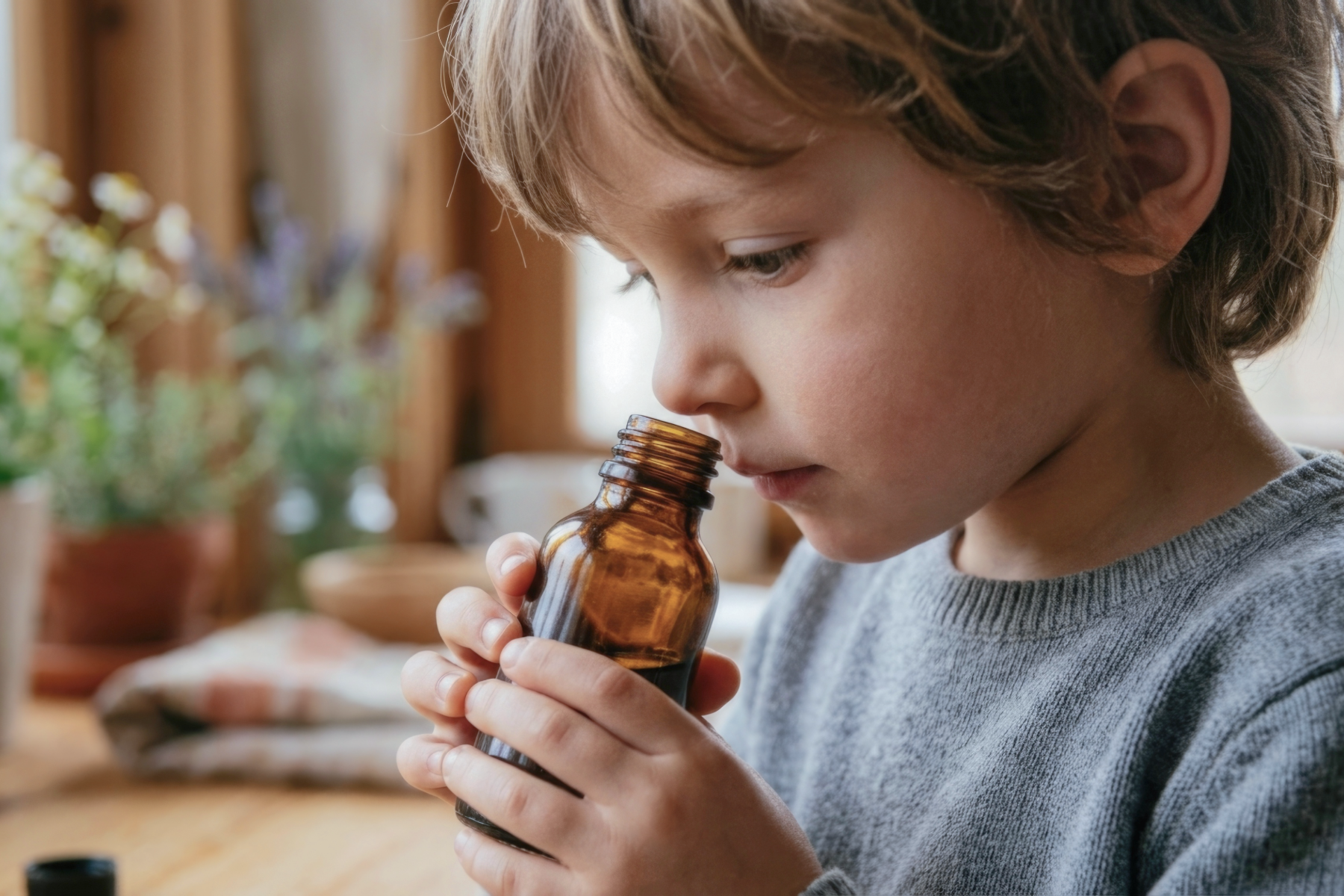
You’re already reaching for the elderberry at the first sniffle. You’ve been using it yourself for years. The real question isn’t whether herbs work — it’s whether he can have what’s already in your cabinet, and if so, how much.
That’s what this guide covers: which common herbs are safe for children, in what form, and how much to give by age. Because knowing an herb is “great for immunity” doesn’t tell you whether your four-year-old can have a dropper of the tincture you take, or whether to brew him a cup of tea instead.
The short answer is that in a well-stocked family herbal cabinet you likely already have what you need that’s safe for your kid — with appropriate dosing. Most of this comes down to three questions: can your kid have it, which form fits, and how much do you give?
Choosing the Right Form and Dose
Most of the confusion around giving herbs to children comes down to two questions: what form makes the most sense here, and how much of it do they actually need? The form changes everything — how fast it works, how easy it is to get into a reluctant kid, how much you use, and whether it goes in the mouth or on the skin. There are a few primary forms that make up the basis of a home apothecary, and each one has a job it does better than the others.
Tea
Tea is the gentlest way to get an herb into a child. For a younger one, you can mix it into juice or a smoothie and they’ll (maybe) never notice it went down. Older kids can drink it straight, sweetened with a little honey if the flavor is bitter.
With genuinely safe herbs like chamomile and nettles, you can give them as much as they’re willing to drink. Careful dosing isn’t generally necessary. That’s part of why tea is the easiest place to start.
Tea can be offered to kids once they start eating table food and drinking from a cup. It fits well into the transition out of newborn infancy. My first was offered tea starting at 20-21 months — due to extended exclusive breastfeeding that was the timeframe for when solid food really became consistently offered. You can start earlier depending on your baby’s transition-to-food timeline.
If you’re offering the herbs to address an acute issue like sinus issues or tummy troubles, tea is often the best place to start because you tend to get a more concentrated dose per cup and with consistent use it can work a little faster than a tincture. For example, I find mullein tincture to be useful to keep allergy symptoms at bay throughout the season with regular use, but if I get a flare up from acute exposure, a few cups of mullein tea throughout the day clears me up faster.
The real trick is whether or not you can get it down your kid in the first place. That’s where this next form comes into play.
Alcohol Tinctures
Tinctures are highly-concentrated herbal extractions usually made from alcohol or glycerin, which makes them useful when you want something to work and only need a little bit to do it. Since doses come by the drop or dropper, it’s easy to sneak into a drink and they’ll never know.
The alcohol content is the part that sometimes gives mothers pause. A single properly diluted dose contains a negligible amount of alcohol — you’re only giving a few drops in a cup of water or juice. Whether that’s something you’re comfortable with is a personal call each mother makes for herself, and there’s no wrong answer. If it’s not for you, glycerites cover the same ground. I personally have no issue with giving my little ones alcohol tinctures because they make superior medicine compared to most glycerin extractions and they’re not getting enough alcohol to matter once properly diluted.
My general rule of thumb is a quarter-sized dose for a quarter-sized human and a half-sized dose for a half-sized human. Kids 2-ish and up can have 3-5 drops at a time once or multiple times per day depending on whether you’re giving general maintenance care or treating something. Older kids can have 5-10 drops. Teenagers can generally have adult-sized doses.
The best practice if you’re not sure is to start on the lower end of the dosing range and increase it until it’s effective. Always dilute a tincture into a drink before you give it to a child — never straight.
Glycerite
A glycerin extraction (often called a glycerite) is an alcohol-free tincture made with vegetable glycerin instead. Vegetable glycerin works especially well for herbs whose useful constituents are water-soluble. Straight glycerin is relatively poor at extracting resins, waxes, and some essential-oil constituents so some herbs really do need the alcohol to pull out all of the beneficial compounds that make for good medicine.
Since many herbs don’t extract well in glycerin, not every “kid-friendly alcohol free” tincture makes for good medicine, even though they’re popular offerings. Make sure you have a trustworthy herbalist who really knows their stuff.
Herbs that work well as glycerites include lemon balm, chamomile, catnip, passionflower, skullcap, tulsi (holy basil), milky oats/oat tops, elderflower, elderberry, marshmallow root, licorice root, nettle, and dandelion. Marshmallow is particularly well suited because glycerin and water pull out its mucilage nicely.
Often, glycerites are given in larger doses than alcohol tinctures, so you’ll want to follow the guidelines on the bottle or from your herbalist. For herbs that don’t extract well, glycerin tinctures run roughly half the strength of an alcohol tincture. Lacking more specific directions, a good rule of thumb is for dosing glycerites is to double the alcohol tincture dose recommendation for that age.
An Elderberry Glycerite is a good example of what this looks like on the shelf — alcohol-free, sweet enough that kids take it without a fight, and easy to dose. It also doesn’t require refrigeration like elderberry syrup and has a much longer shelf life. It’s why elderberry tends to stay stocked in a house with young children, especially during immune support heavy seasons like back-to-school time and the winter months.
Salves
Salves are topical and low-stakes. This is what you use for a burn, a scrape, or a bug bite. You rub it on the skin, keep it handy to reapply a little later, and you’re good to go. A little goes a long way, and they’ll hit a point fairly young to self-manage use (although they may not be using “a little” if you turn them loose).
The catch is to choose a salve with gentle herbs such as chamomile and calendula rather than ones that carry high risk of internal harm if consumed like arnica — because we know little ones like to touch everything including boo-boos and their mouths.
Salves can be used from birth — think diaper balm. As your baby gets older, you can expand the herbs you can use safely. The Bum Bum Balm I make for LunaTerra Apothecary has calendula, chamomile, and lavender and no essential oils to make for a super safe and gentle option (that also can double as a nipple balm).
Essential Oils
Essential oils are potent, and they need to be diluted before topical use — a 1–2% dilution, applied to the temples, chest, wrists, or feet makes for easy medicine. You can also skip the skin entirely and diffuse them into the air. Aromatherapy is the gentler entry point, especially for little ones ages 12-24 months who are really too young for topical essential oil use but old enough to use a gentler form safely.
Not every essential oil can be used safely with children. Some are too harsh, some are irritating, and some are photosensitizing, meaning they react badly with sunlight on the skin. As a general rule, wait until age 2 for topical use, and keep in mind that certain oils should be delayed longer than that.
There’s one practical detail worth knowing for young children. A toddler will tend to touch wherever you applied the oil and then (of course) put their hands in their mouth, and most essential oils are not meant to be swallowed. A little lavender isn’t going to hurt at that level, but it also doesn’t hurt to be cautious. An easy way around this is to apply to the bottoms of the feet and cover them with socks, or put the oil somewhere else under clothing where little hands can’t reach it.
I’ve formulated a good portion of our essential oil blends for LunaTerra Apothecary to be safe from age 2 onward to have more inclusive options for the ones at the age when finding safe herbs is harder. The Chill Out roller is a specific example of a child-appropriate blend — lavender, ylang ylang, and bergamot, diluted to 2% and safe from age 2. My toddler loves this blend, and I don’t mind turning him loose with the roller as long as he’s supervised, doesn’t stick it in his mouth, and we wash hands after he’s done a significant amount of “rubbing it in” to get off any excess that will inevitably end up on the furniture, a cat, or in his mouth.
Quick Reference Chart: How Much of What, By Age
Here’s your cheat sheet — and a few things to keep in mind as you develop your kid-friendly home apothecary.
The world of herbs opens up a lot once your child is eating table food and drinking from a cup. You still have to stick with gentle options, but those options become available. Never give herbs directly to an infant. For babies, there are many safe topical herbs but for internal support, a nursing mother can take an adult sized dose for herself of the safe remedy and the dose will transfer to the infant through the milk.
Use the chart below to reference the age, dose, and a few of my best tricks for each type of herbal preparation.
| Form | Age | Dose | Tricks |
| Tea | once they start eating table food and drinking from a cup | as much as they’re willing to drink | mix it into juice or a smoothie to hide the flavor if they won’t drink it straight |
| Alcohol Tincture | 18-24 m (my preference is to offer through breastmilk as long as possible) | Kids 2-ish and up get 3-5 drops once or 3-5x per day depending on whether you’re giving general maintenance care or treating something. Older kids (5-6 years+) can have 5-10 drops. Teenagers can generally have adult-sized doses. | alcohol content is negligible if well diluted; size of child matters so start on the lower end of amount and frequency and give more until effective |
| Glycerite | 18m ish (can offer diluted in drink) | generally double the alcohol tincture recommendation; consult bottle for specific directions | not every herb works well in this form but easier to offer since its sweet |
| Salve | birth for many very gentle herbs (think diaper balm) | a smear as often as needed | if you’re using a salve that shouldn’t be consumed cover the skin once applied |
| Essential Oil | 2 years (see exception in Tricks) | 1-2% dilution | can use aromatherapy younger (12m+ for gentle oils like lavender); exception is clove oil used on gums for teething at even greater dilution (get it here: Teething Baby Roller); apply to the bottoms of the feet and cover them with socks, or put the oil somewhere else under clothing where little hands can’t reach it to keep them from transferring oil to mouth |
What’s Actually in the Cabinet
Knowing the forms and doses is one piece of it. The other piece is knowing which herbs are actually worth keeping on hand for a child — what they do, why they work, and when you’d reach for them. This isn’t a comprehensive catalog of every plant ever used in children’s herbalism. It’s the practical list: the ones that show up repeatedly in our own family home apothecary because they’re safe, effective, and versatile.
Most of these herbs do several things well which makes them excellent choices for keeping stocked.
Immune Support
Elderberry is probably the first herb most mothers come across when they start looking into kids and herbs. It’s perhaps the most popular remedy to keep on hand for immune support. The flavonoids in elderberry have antiviral activity — they interfere with a virus’s ability to replicate and enter cells. It works best if you give it at the first sign of something coming on rather than waiting to see how bad it gets.
For a child who still resists most things that look or smell herbal, an elderberry glycerite is usually the answer. It’s sweet, alcohol-free, and easy to give straight or stirred into a drink. There’s also no refrigeration required, which also means it doesn’t get lost in the back of the fridge and forgotten.
During immune-heavy seasons — back to school, winter, any stretch when every kid in the neighborhood seems to be passing something around — keeping elderberry stocked is a good option.
I keep our Elderberry Glycerite and Hug in a Cup Tea (elderberry, ginger, cinnamon + optional add your own honey) on hand as family-friendly, elderberry-based options. Both are highly effective and give me the option for a dose by dropper or a warm cup depending on what the moment calls for.
Respiratory Support
Mullein is a favorite for all things sinus, lungs, and allergies. It works directly on irritated lung tissue — soothes, loosens mucus, and helps the airways clear. For a cough or congestion, mullein can work fairly quickly with consistent use.
This is one I use as both tea and tincture, but not for the same reason. I’ve found the tincture to be more useful for regularly seasonal support or for getting a dose into a child who won’t drink tea. It’s also my go-to to help breastfeeding babies with stuffy noses (see the “Note On Safety” section below). When the issue is more acute, I generally opt for tea instead as it seems to work a little deeper, faster.
The Just Breathe Tea (mullein, echinacea, ginger) is layered with complementary herbs to help clear the gunk. Mullein Tincture is the option if you want fast and easy to disguise. These are two I rely on heavily as staples in our family.
Digestion
Chamomile is extremely gentle and helps with a variety of ailments (including digestion, sleep, and wound care), making it one of the most useful herbs in the house for children. For the kid who woke up with a stomachache or can’t wind down at the end of the day, the answer is often the same: a cup of chamomile tea and a little honey. It calms smooth muscle in the gut, which is why it settles cramping and bloating. For a child too young for teas and tinctures, a little chamomile-infused oil or salve rubbed on the belly works for aiding digestion.
Peppermint is useful for older kids with nausea or an upset stomach. The caution with peppermint is its strong menthol content, which can be irritating and is not appropriate for very young children — and the essential oil will burn if it gets in eyes or on very sensitive skin. For a six-year-old with a car-sick stomach or post-meal nausea, peppermint tea or a diluted roller on the belly works wonders. For a toddler, a weak peppermint tea is fine but use discernment on their maturity level as they get older before offering the essential oil.
Sleep and Calming
Chamomile a go-to for wind down time. It has a mild sedative effect on the nervous system which helps with sleep onset. A cup of tea after dinner can help with prepping for the bedtime transition in the evenings. Diffused or topical essential oil is also a gentle option while climbing in bed.
Lavender is another extremely gentle option that can be used topically or aromatically. A drop of essential oil in the diffuser is even safe for babies, although I’d wait until at least 6+ months before using any essential oils even in the diffuser. Most kids probably aren’t going to touch lavender tea because the flavor is quite strong, although yours might have a unique palette. Mine likes our Lazy Afternoon tea which has very subtle lavender undertones and is designed to relax without sedating.
Our Night Night roller blends lavender, chamomile, and sandalwood for an extremely gentle yet effective blend — which my own two-year-old loves to use. For supporting the nervous system without sedating, we also love the Chill Out roller which blends lavender with ylang ylang and bergamot. When he asks me for “oil”, that’s the one he wants.
Minerals and Nourishment
This category often gets overlooked because it doesn’t feel like medicine. But if your child is in a growth phase, coming off illness, eating a limited variety of foods, or just running hard — mineral support is a good addition to your rotation.
Nettles are dense with iron, calcium, magnesium, and vitamin C and one of our favorites to include in teas or meals. Dandelion supports the liver and helps the body absorb nutrients from whatever else a child is eating.
Neither of these is a quick fix for acute issues. They work when used consistently, which is part of why a tea blend makes the most sense for this category. The Everyday Mineral Tea (dandelion root, nettles, milky oats, alfalfa) is exactly what it sounds like: a tea you can share with the whole family, including a pregnant mama, a toddler who wants whatever you’re having, and a daddy who the toddler likes to feed. Which is how it plays out in our household.
Wound & Skin Care
For anything on the skin — a scrape, a minor burn, a rash, a bug bite — calendula and chamomile are the two workhorses I keep on hand most often in salve form. Both are anti-inflammatory, both are gentle enough for newborn skin, and neither causes harm if a curious toddler licks the spot where you applied it.
I formulated our Bum Bum Balm specifically to be very baby safe: calendula, chamomile, lavender, no essential oils. It works as a diaper balm from birth and pulls double duty as a nipple balm during breastfeeding.
As children get older, you can include a wider range of herbs safely but calendula and chamomile tend to remain anchor herbs for me. Our Ouchie Magic and Bite & Sting balms are the most popular for growing little ones — and I actually used both on my baby from age 1 in small amounts while ensuring he couldn’t get it into his mouth. I also keep Burn Balm in the kitchen drawer in case someone touches a forbidden hot pan or gets a little pink in the sun.
A Note on Safety and What “Insufficient Data” Actually Means
You’ll come across a lot of herbs labeled “insufficient evidence for use in children”. Sometimes it’s maddening when I’m looking for a remedy and keep getting stonewalled by lack of data. Here’s how I deal with it.
In most cases, “insufficient evidence” means no one funded a controlled pediatric study — not that the herb is dangerous (although some herbs are dangerous for kids). Plants like chamomile and nettles have been used safely with children for centuries across many cultures. The absence of a modern trial is not evidence of risk.
That said, some herbs do carry genuine caution for children, and it’s worth knowing the difference between “not studied” and “actually contraindicated.” Obviously, if an herb carries explicit “do not use” risk, don’t use it. For the grey areas — when in doubt, choose a different herb. There’s almost always another option that does the same thing you need.
Sometimes you have to use your judgement. As you use herbs more often and get more comfortable with how one works, your judgement will become more discerning. When I bump up against a common herb that has no explicit safety determination, there are a few things I consider to make a decision about what to offer:
- What is the action of the herb and the potential side effects? Does it affect hormones, milk supply (if breastfeeding), or intensely modulate a body system? If so, I skip it.
- Is there a high risk of allergic reaction? Is a parent or sibling allergic to this plant family that could indicate whether the child receiving the medicine might be, too?
- What’s the pharmaceutical alternative and its side effects? For me, these are high-risk options (Tylenol is a known liver toxin, for example). If the herb is lower risk, I’d rather start there.
A small dose of a mild herb, watched closely, is a reasonable thing for a mother to decide on her own if she can clearly walk through these answers.
Here’s how this showed up for me in practice:
My 3-month-old was congested and struggling to nurse because he couldn’t breathe through his nose. Mullein is my usual go-to for respiratory issues and congestion. Since he was so little and nursing full-time, I couldn’t give herbs to him directly, so I considered what I could take and transfer to him.
While mullein doesn’t have an explicit “safe or unsafe” for breastfeeding determination, I considered the potential risks and effects:
- Allergic reaction? Not likely
- Drop in milk supply? Mullein doesn’t work on hormones, so not likely. Most herbs that do this drop milk supply slowly, so I would have a chance to notice and stop taking it if necessary.
- Other common risks? Low: no hormonal action or intense modulation on a body system
- Adult dosing: Not a low-dose botanical and wide margin of safety, so no risk of overdosing myself
With all this in mind, I took a dose of mullein tincture myself in the evening as a test. He nursed through the night and had no negative response. My milk supply seemed fine. I took another 3 doses throughout the next day, and by bedtime J was completely clear with no adverse reactions. I determined this was a safe herb for us to use, and we’ve used it very successfully ongoing as needed.
I could have considered lobelia for respiratory support, but lobelia is a low-dose botanical that also acts as a muscle relaxant. Those two factors make lobelia high-risk, so a gentler herb was required.
Using Judgment, Not Just a Chart
When in doubt, use the gentlest option. Start with lower doses. Watch your child. Skin test anything new if allergy is a concern before giving it internally. If a child is on medication or under a doctor’s care for something specific, check for herb-drug interactions before adding anything. And if you ever see a reaction — stop using it, and seek help if the situation warrants it.
Not every safe herb works for every child. If something gentle just isn’t doing anything for your family, it doesn’t mean the herb doesn’t work — it just might not work well for your child. Simply try something else.
You do not need a pharmacy’s worth of products or a master herbal education before you can care for your child well. You need a few genuinely safe herbs, a basic understanding of what to use when, and enough discernment to make the decision and pay attention. That is how most of this is learned anyway — not by memorizing a hundred plants at once, but by reaching for chamomile for the stomachache, mullein for the rattly cough, calendula for the rash, and slowly building a cabinet and confidence that match each other.